Your scrollable content goes here

Debt Validation Letter: Your Guide to Debt Collector Verification and What to Do When You Receive One
If a letter from a collection agency has recently arrived claiming you owe a debt, understanding exactly what that document means and what you are legally entitled to demand from the collector is the most important step you can take before responding or making any payment.
This guide is written for U.S. consumers who have received a debt validation letter and need to know how to read it, what it must contain under federal law, and what their rights are if anything seems wrong.
by Cirqul
•
May 29, 2026
•
Resolve
Key Takeaways
A debt validation letter is a federally required notice that a debt collector must send you within 5 days of first contact
If you dispute the information contained in the debt validation letter within 30 days from receipt, the collections agency is required to pause all collection activity until they review and verify the disputed debt
The letter must include the debt amount, the original creditor's name, and a clear statement of your right to dispute
Do not make any payment before verifying the information in the letter against your own financial records
If the letter is missing required information, contains errors, or you never received one at all, you have legal options under the Fair Debt Collection Practices Act
Violations can be reported to the CFPB or FTC, and consumers may be entitled to damages if collectors break the rules
Key Facts Governing Law: Fair Debt Collection Practices Act (FDCPA), 15 U.S.C. § 1692 Jurisdiction: United States (applies to third-party debt collectors; some states have additional protections) Critical Timeframes:
Collector must send validation notice within 5 days of first contact
Consumer has 30 days from receipt to dispute
Collection activity must pause after a written dispute is received
Where to Report Violations: Consumer Financial Protection Bureau (consumerfinance.gov) or Federal Trade Commission (ftc.gov)
Table of Contents
What Is a Debt Validation Letter and Why Did You Receive One?
A debt validation letter, also called a validation notice, is a document that a debt collector is legally required to send you when they begin attempting to collect a debt. It is not a lawsuit, a judgment, or a final demand. It is a federally mandated disclosure that gives you the opportunity to confirm that the debt is real, accurate, and actually yours before taking any action.
You received one because a collection agency has taken over an account you previously held with a creditor, such as a credit card issuer, medical provider, or lender, and is now attempting to collect the balance. In some cases, the debt may have been purchased by debt buyers: companies that acquire charged-off debt from original creditors and then collect on it themselves. Debt buyers are bound by the exact same FDCPA rules as any other collector.
Receiving a debt validation letter does not mean you must pay immediately. It means the formal collection process has begun and your consumer rights are fully in effect.
What Are Debt Collectors Required to Send and When?
Debt collectors have a legal obligation under the Fair Debt Collection Practices Act to send a validation notice within five days of their first contact with you, regardless of whether that contact was by phone, letter, or any other means.
The notice must provide you with key information, including:
The total amount of the debt being claimed
The name of the creditor to whom the debt is currently owed
Your right to dispute the debt within 30 days of receiving the notice
What happens if you do or do not dispute within that window
How to request the name and address of the original creditor if it differs from the current collector
These are not discretionary items. They are federal requirements. If a debt collector contacts you repeatedly without sending this notice within five days of first contact, they are already in violation of federal law. Keep a record of every date and method of contact from the moment any collection agency first reaches out to you.
What Must a Debt Validation Letter Contain by Law?
Knowing what a legally compliant debt validation letter must contain helps you immediately identify whether what you have received is complete and valid. Review the letter against these required elements:
The name and address of the collection agency attempting to collect
The full amount of the debt, including any interest or fees that have accrued
The name of the original creditor, the business you originally owed the money to
A clear statement of your right to dispute the debt within 30 days of receiving the notice
A statement that the debt will be assumed valid if you do not dispute it within that timeframe
Your identity as the account holder, with your name and account details accurately reflected
Validation information that clearly connects the debt being collected to a specific account in your financial history
A validation notice missing any of these required elements may be non-compliant. Note what is absent, document the date you received the letter, and respond in writing before your 30-day window closes.
How Do You Read and Verify a Validation Notice?
Once you have the letter in hand, do not accept the validation information at face value. Cross-reference every element carefully against your own financial records before taking any action, including making a payment.
Use this checklist when reviewing what you have been sent:
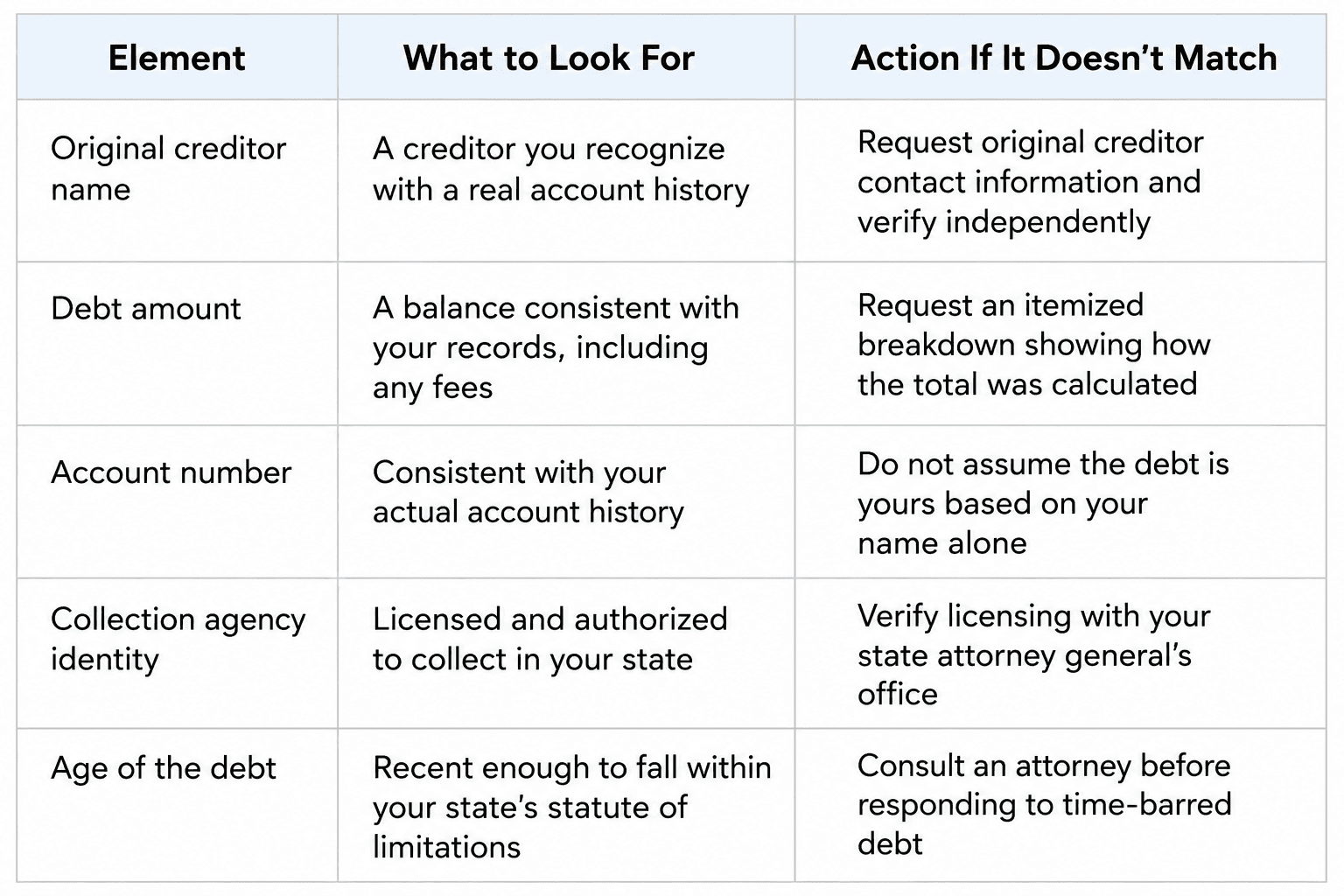
Also pull your credit report. If this account has been reported to the credit bureaus, it should appear there. Cross-referencing the validation notice against your credit report helps confirm whether the details are consistent and whether the account is being reported accurately. You can access free reports from all three major bureaus at AnnualCreditReport.com.
What Are the Red Flags in a Collection Agency's Validation Letter?
Once you have the letter in hand, do not accept the validation information at face value. Cross-reference every element carefully against your own financial records before taking any action, including making a payment.
Not every letter from a collection agency will be fully compliant. Debt buyers in particular sometimes work from incomplete records and may send validation letters that are missing key details or contain outright errors.
Watch for these warning signs:
No original creditor identified. You have the right to request that information in writing before taking any action.
Vague or rounded debt amounts. A legitimate debt should have a documentable history. If the amount lacks explanation of fees or interest, request an itemized statement.
No reference to your dispute rights. Failing to inform you of your 30-day right to dispute is a direct FDCPA violation.
Pressure to pay before you can verify. Urgency tactics that discourage you from examining validation information carefully are a warning sign. The debt collection process should allow you a reasonable time to review your account, especially if you think there are issues.
Errors in your identity or account details. A misspelled name, wrong address, or unfamiliar account number should be flagged immediately and in writing.
If the letter is incomplete or contains errors, document everything and send a written response to the collection agency before your 30-day window closes.
How Do You Confirm the Original Creditor and Verify the Debt Is Yours?
One of the most important pieces of validation information in any debt collection notice is the name of the original creditor: the company you originally had a personal agreement or account with, such as a credit card issuer, hospital, lender, or utility provider.
Debt is frequently sold in portfolios, meaning a credit card balance or personal loan may have changed hands multiple times before reaching the collection agency that contacted you. Each transfer can introduce errors, outdated balances, or misattributed accounts. Debt buyers do not always receive complete records, which means the figure they are attempting to collect may not accurately reflect what was actually owed at the time of sale. Collectors sometimes pursue accounts that have already been settled, discharged in bankruptcy, or paid in full by the original account holder.
To confirm the debt is legitimate and that you are the correct responsible party:
Contact the original creditor directly, using contact information you find independently rather than the number printed on the collection letter
Ask them to confirm whether the account was sold, to whom, and what the balance was at the time of transfer
Request your original account statements if you no longer have them
Compare that verified information against the validation notice you received
What Should You Do If You Dispute the Debt?
If you review the debt validation letter and believe the debt is not yours or the amount is inaccurate, you have 30 days from receipt to formally dispute it and trigger a pause on collection activity. You may still dispute the debt after the initial 30 day window, but there is no mandatory pause on activity
Your dispute should be a written request. Send it via certified mail with return receipt so you can prove it was received and when. In your verification letter, state clearly that you are disputing the debt and explain the basis of your dispute. Once the collection agency receives your written dispute:
If disputed within the 30 day window, they must stop all collection activity until they can validate that the debt is real and that you are the responsible party
They may not be able to report the account to the credit bureaus as valid during this period, but some reporting may continue if the agency is required to update the bureaus that the account has been disputed
If they cannot validate, they must cease collection entirely
If the collector continues contact after receiving your timely dispute or reports the account without first resolving the validation process; you can file a consumer complaint with the CFPB at consumerfinance.gov or the FTC at ftc.gov. FDCPA lawsuits can recover actual damages, statutory damages up to $1,000, and attorney's fees.
What Is Debt Verification and What If You Never Received a Validation Letter?
Debt verification is the process by which a collector confirms that a debt is legitimate, accurately calculated, and legally collectible. In a compliant collection process this happens automatically: the collector sends the validation letter and, if disputed, provides documentation to support their claim.
If a debt collector has been contacting you but you have never received a formal validation notice, they may already be in violation of the FDCPA. In this situation, send your own written request based on a debt validation letter template, formally asking the collector to validate and verify the debt. You are effectively the consumer asking them to demonstrate they have legal standing and that the balance they are claiming is accurate.
Debt validation letters sent by consumers may trigger the same pause on collection activity. Once received, the collector may be required to respond before resuming any collection efforts. Send your request via certified mail. If the collector cannot validate the debt in response to your written request, collection on the account should stop entirely. The burden of proof belongs on the party making the claim.
What Are Your Rights Under the Fair Debt Collection Practices Act?
Collectors must send a validation notice within 5 days of first contact
You have 30 days from receipt to dispute the debt and trigger a mandatory collection pause until the collection agency has verified the debt
You can still dispute the debt after the initial 30 days, but there is no mandatory collection pause
Debt collectors cannot harass, threaten, deceive, or misrepresent your debt or their identity
An unverified debt cannot be reported to the credit bureaus as valid
A cease-and-desist letter stops direct contact, though it does not eliminate the debt itself
You have the right to sue a non-compliant collector in federal or state court
Violations are reportable to the CFPB and FTC, and consumers may be entitled to damages
Frequently Asked Questions
What is the difference between a debt validation letter and a debt verification letter? These terms are often used interchangeably, but technically a validation letter is the initial notice a collector sends to inform you of the debt and your rights. A verification letter is what they send in response to your written dispute, containing documentation that proves the debt is real and yours. Both are part of the same process under the FDCPA.
How long does a debt collector have to respond to my dispute? The FDCPA does not set a specific deadline for the collector's response, but they must cease all collection activity, including credit bureau reporting, until they provide adequate verification. If collection activity continues without a valid response, that is an FDCPA violation you can act on.
Can a debt validation letter stop a debt collector from contacting me? Receiving a validation letter does not stop contact, but sending a written dispute in response does trigger a mandatory pause. If you want to stop contact entirely, a separate cease-and-desist letter is required. Be aware that while a cease-and-desist stops communication, it does not prevent the collector from pursuing legal action to collect the debt.
What if the debt on the validation notice is not mine at all? Dispute it in writing immediately within your 30-day window. Identity errors, data mistakes, and misattributed accounts are more common than most consumers expect, particularly when debt has changed hands through debt buyers. State clearly in your written request that you do not recognize the debt and ask the collection agency to validate it with complete documentation.
Does requesting debt validation hurt my credit? No. Requesting validation is a consumer right and does not affect your credit report or score. However, if the debt has already been reported and you dispute it successfully, the inaccurate entry may be removed, which could improve your credit standing.
What if I recognize the debt but disagree with the amount? You can still dispute the amount even if you acknowledge the underlying debt. Send a written dispute explaining that while you recognize the original account, you dispute the balance as calculated. Ask for an itemized statement showing the original principal, any interest, fees, and the date each charge was applied.
Still Have Questions? Ask CARA
Navigating debt collection can feel like a lot to sort through on your own. CARA is an AI agent available right here on this page. CARA can help you understand what's in your validation letter and walk you through your options. CARA does not provide legal advice. Click the chat icon to start the conversation.
Ask CARA
If you have received a debt validation letter and are unsure whether it is accurate or legally compliant, a nonprofit credit counselor or consumer rights attorney can review your personal financial situation and your options, often at no cost.
This article is provided by Cirqul for general informational and educational purposes only. It does not constitute legal advice and should not be relied upon as a substitute for advice from a licensed attorney in your jurisdiction. Reading this article, contacting Cirqul, or interacting with CARA does not create an attorney-client relationship between you and the author, Cirqul, or any of its affiliates or employees.
Debt collection laws vary by state, and the application of federal law to any particular situation depends on the specific facts involved. If you have received a debt validation letter or are facing a debt collection matter, you should consult a licensed consumer rights attorney or a nonprofit credit counselor about your individual circumstances.
Cirqul is a debt collection agency licensed in multiple states. Communications with Cirqul or CARA may be used in connection with the collection of a debt, where applicable.